Label: Vee Jay Records
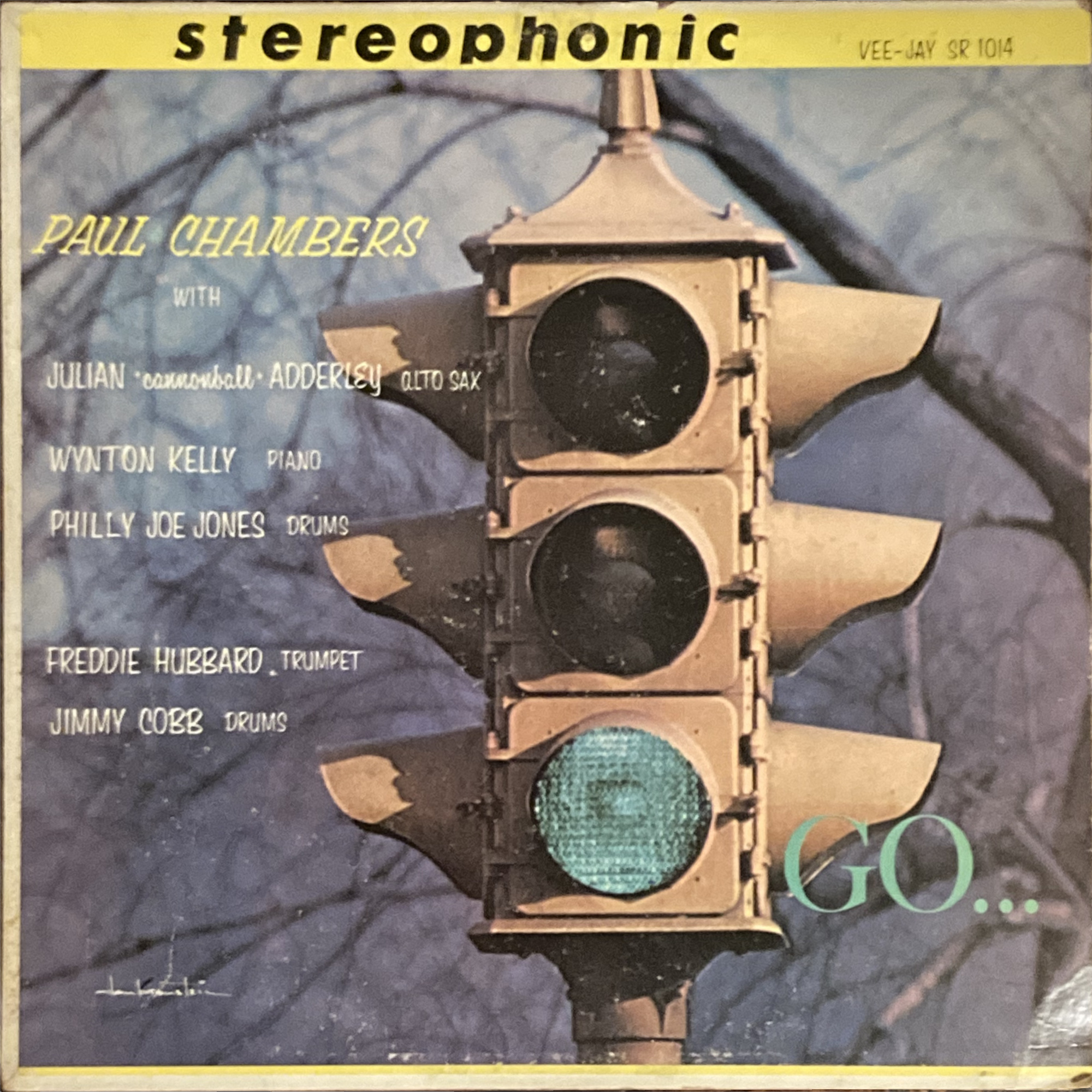
No.: SR 1014
Title: GO…
Musician: PAUL CHAMBERS
Recorded: 1959/2/2
Stereo
Cover address:
Coating
Groove Guard
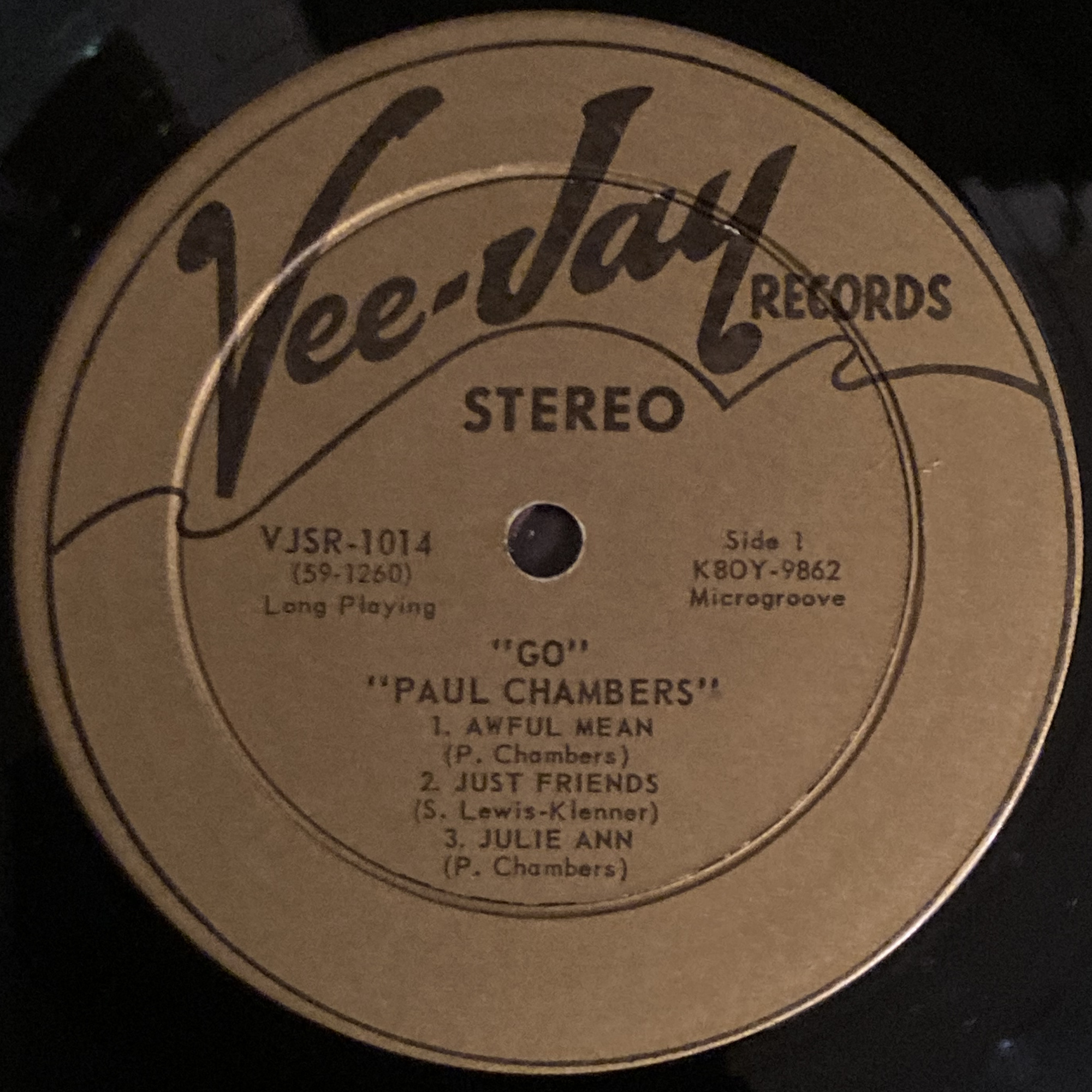
Label Side-A
Gold Background
Black Letter
Address: None
Deep Groove
Dead Wax Info: K8-0, Y9862-1, φ1
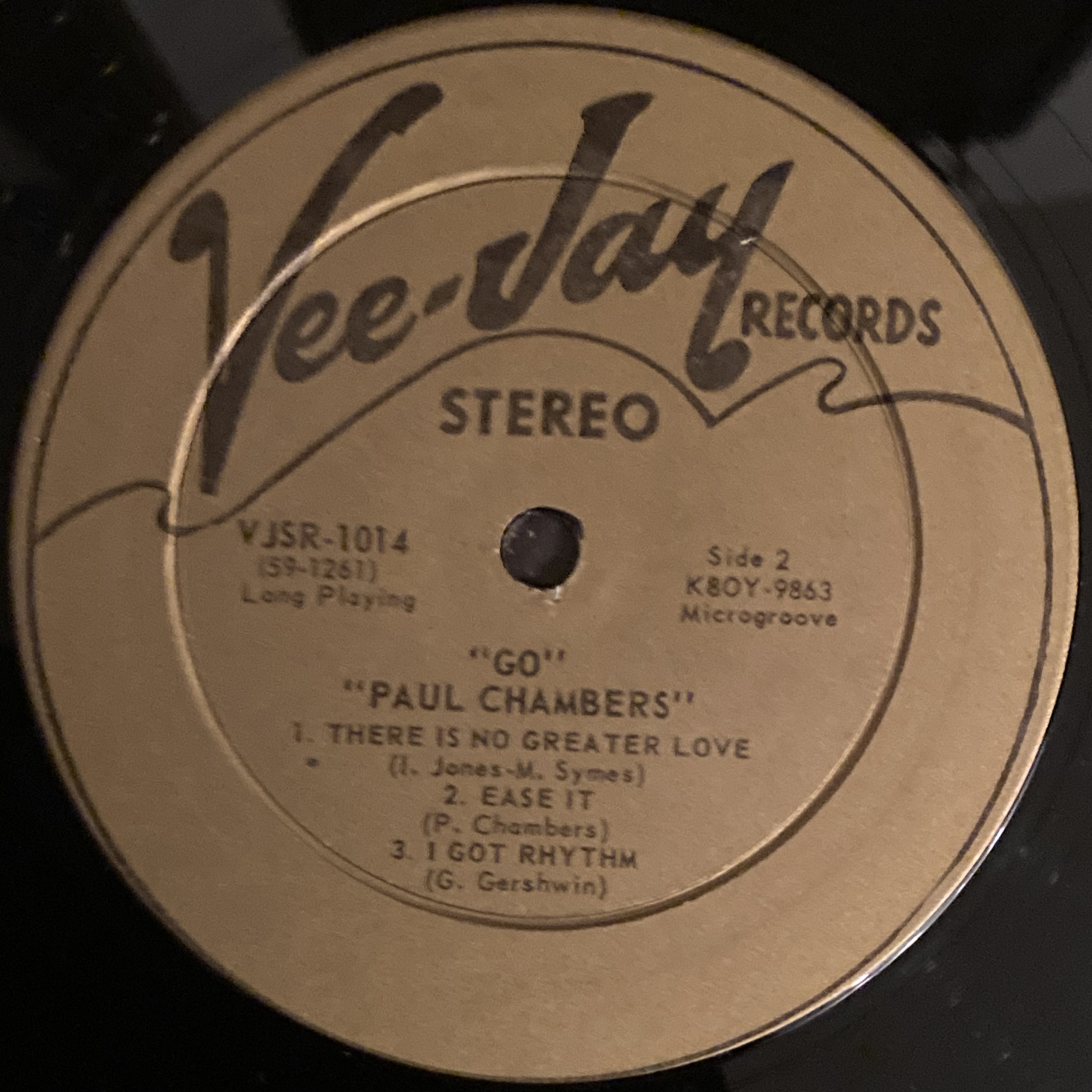
Label Side-B
Gold Background
Black Letter
Address: None
Deep Groove
Dead Wax Info: K8-0, Y9863-1, φ1
Personnel-
Drums: Philly Joe Jones, Jimmy Cobb
Bass: Paul Chambers
Piano: Wynton Kelly
Alto Sax: Cannonball Adderley
Trumpet: Freddie Hubbard
Tracks-
Side-A
1) Awful Mean 6’27”
2) Just Friends 5’14”
3) Julie Ann 6’13”
Side-B
1) There is no Greater Love 8’16”
2) Ease it 5’40”
3) I Got Rhythm 6’24”
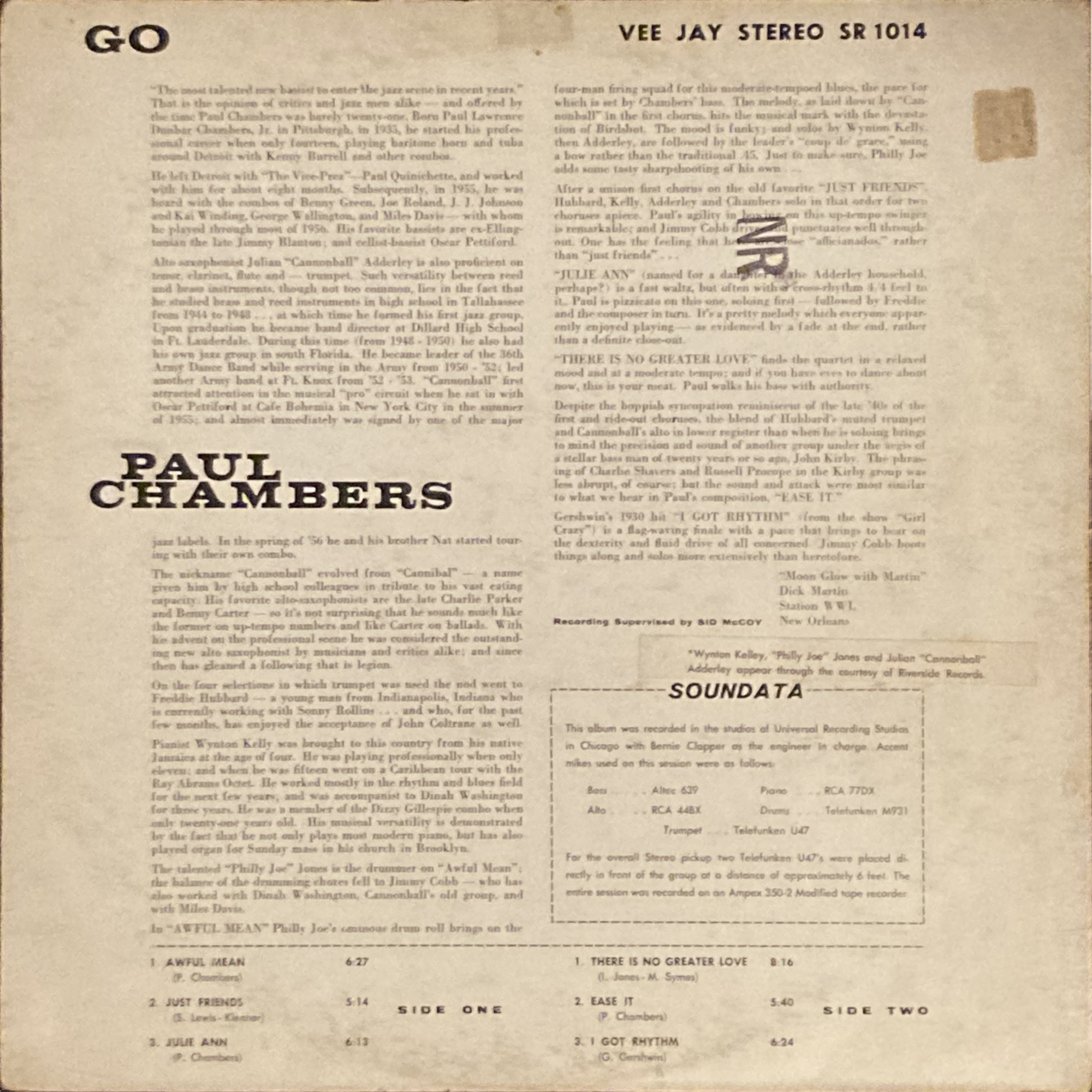
<裏ジャケ原文>
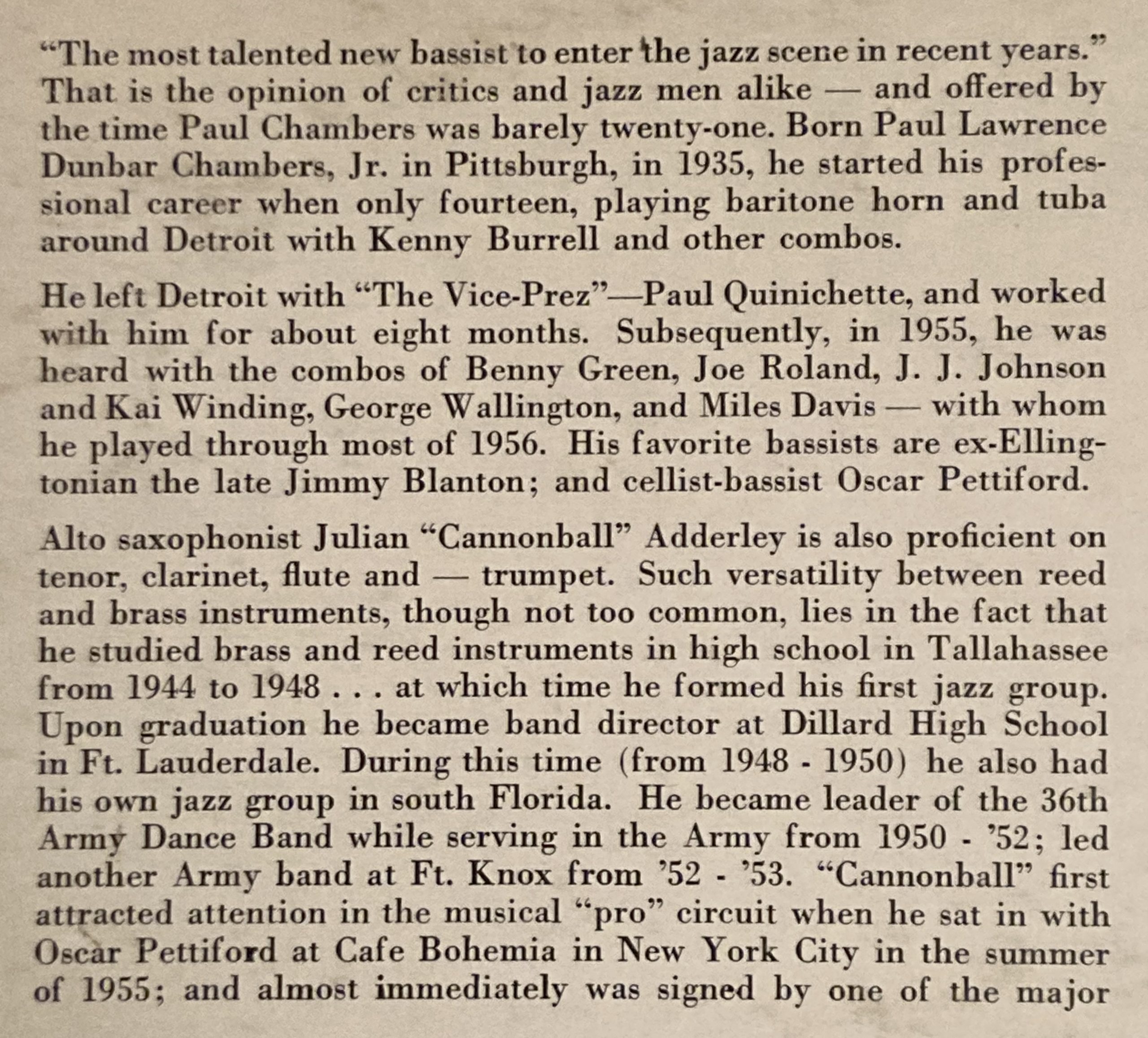
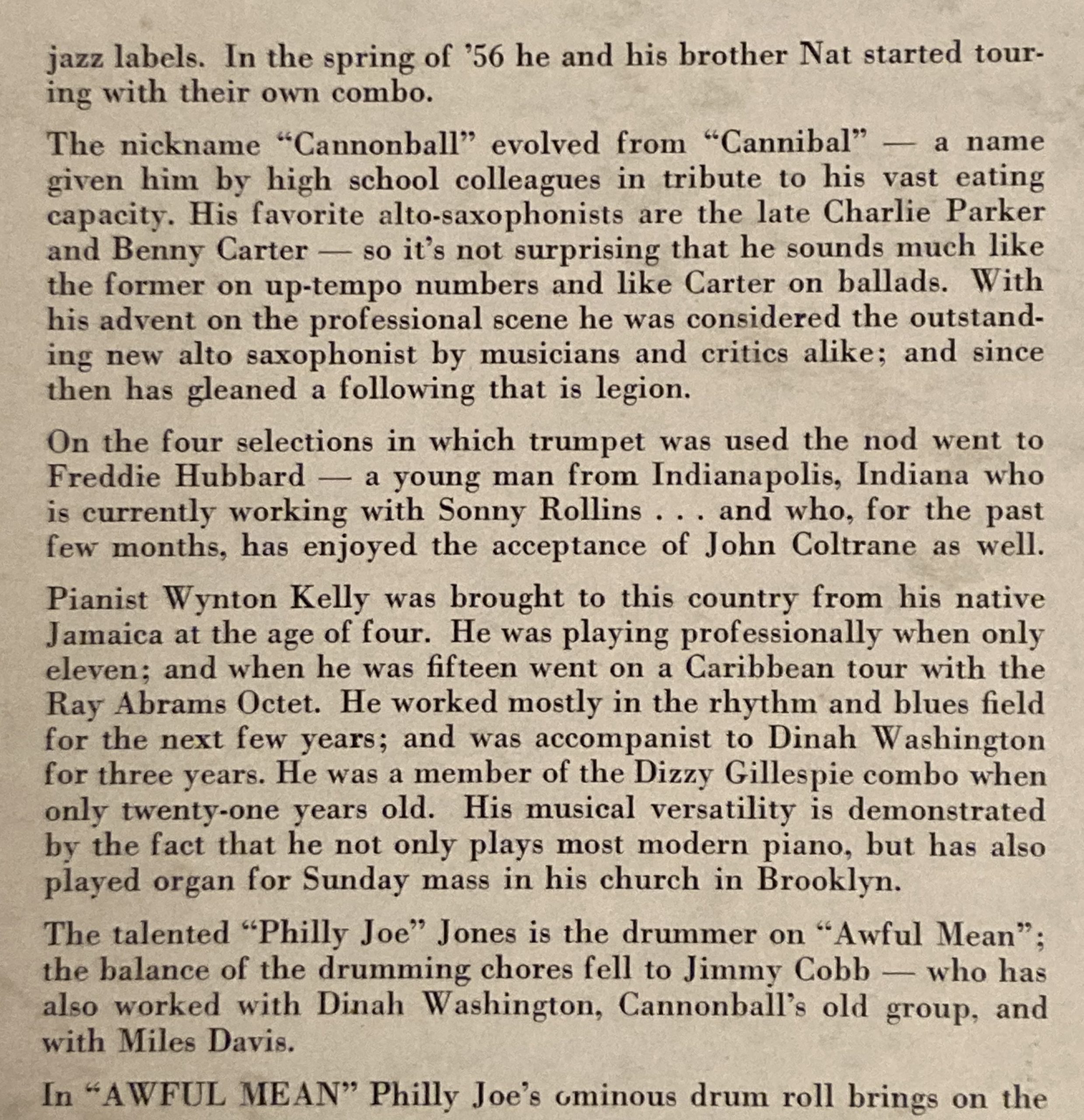
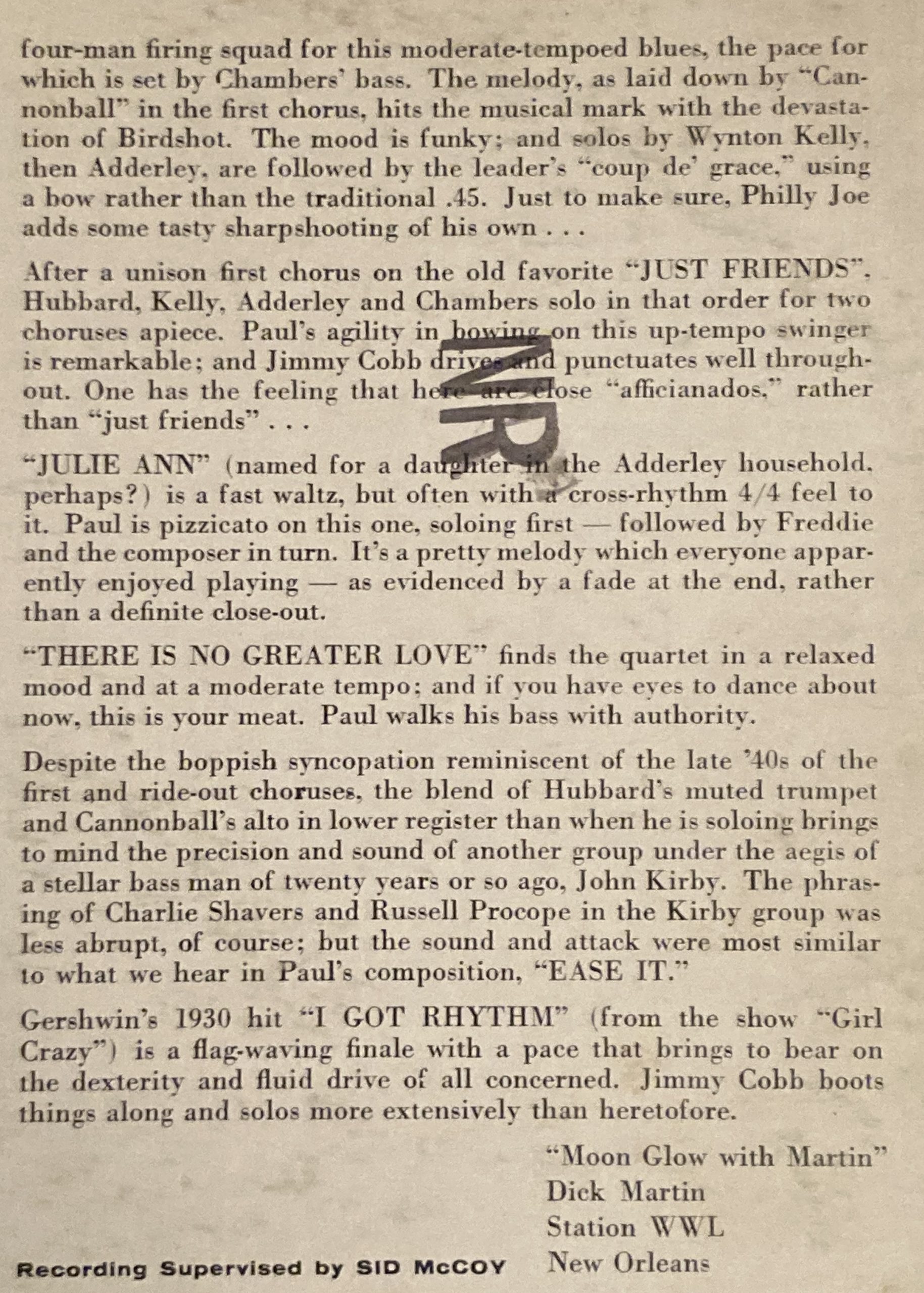
“The most talented new bassist to enter the jazz scene in recent years. That is the opinion of critics and jazz men alike and offered by the time Paul Chambers was barely twenty-one. Born Paul Lawrence Dunbar Chambers, Jr. in Pittsburgh, in 1935, he started his profes- sional career when only fourteen, playing baritone horn and tuba around Detroit with Kenny Burrell and other combos.
He left Detroit with “The Vice-Prez”-Paul Quinichette, and worked with him for about eight months. Subsequently, in 1955, he was heard with the combos of Benny Green, Joe Roland, J. J. Johnson and Kai Winding, George Wallington, and Miles Davis – with whom he played through most of 1956. His favorite bassists are ex-Elling- tonian the late Jimmy Blanton; and cellist-bassist Oscar Pettiford. Alto saxophonist Julian “Cannonball” Adderley is also proficient on tenor, clarinet, flute and trumpet. Such versatility between reed and brass instruments, though not too common, lies in the fact that he studied brass and reed instruments in high school in Tallahassee from 1944 to 1948… at which time he formed his first jazz group. Upon graduation he became band director at Dillard High School in Ft. Lauderdale. During this time (from 1948-1950) he also had his own jazz group in south Florida. He became leader of the 36th Army Dance Band while serving in the Army from 1950 ’52; led another Army band at Ft. Knox from ’52 – ’53. “Cannonball” first attracted attention in the musical “pro” circuit when he sat in with Oscar Pettiford at Cafe Bohemia in New York City in the summer of 1955; and almost immediately was signed by one of the major jazz labels. In the spring of ’56 he and his brother Nat started tour- ing with their own combo.
The nickname “Cannonball” evolved from “Cannibal” – a name given him by high school colleagues in tribute to his vast eating capacity. His favorite alto-saxophonists are the late Charlie Parker and Benny Carter – so it’s not surprising that he sounds much like the former on up-tempo numbers and like Carter on ballads. With his advent on the professional scene he was considered the outstand- ing new alto saxophonist by musicians and critics alike; and since then has gleaned a following that is legion.
On the four selections in which trumpet was used the nod went to Freddie Hubbard – a young man from Indianapolis, Indiana who is currently working with Sonny Rollins . . . and who, for the past few months, has enjoyed the acceptance of John Coltrane as well. Pianist Wynton Kelly was brought to this country from his native Jamaica at the age of four. He was playing professionally when only eleven; and when he was fifteen went on a Caribbean tour with the Ray Abrams Octet. He worked mostly in the rhythm and blues field for the next few years; and was accompanist to Dinah Washington for three years. He was a member of the Dizzy Gillespie combo when only twenty-one years old. His musical versatility is demonstrated by the fact that he not only plays most modern piano, but has also played organ for Sunday mass in his church in Brooklyn. The talented “Philly Joe” Jones is the drummer on “Awful Mean”; the balance of the drumming chores fell to Jimmy Cobb who has also worked with Dinah Washington, Cannonball’s old group, and with Miles Davis.
In “AWFUL MEAN” Philly Joe’s ominous drum roll brings on the four-man firing squad for this moderate-tempoed blues, the pace for which is set by Chambers’ bass. The melody, as laid down by “Can- nonball” in the first chorus, hits the musical mark with the devasta- tion of Birdshot. The mood is funky; and solos by Wynton Kelly, then Adderley, are followed by the leader’s “coup de’ grace,” using a bow rather than the traditional .45. Just to make sure, Philly Joe adds some tasty sharpshooting of his own…
After a unison first chorus on the old favorite “JUST FRIENDS”, Hubbard, Kelly, Adderley and Chambers solo in that order for two choruses apiece. Paul’s agility in bowing on this up-tempo swinger is remarkable; and Jimmy Cobb drives and punctuates well through- out. One has the feeling that here are close “afficianados,” rather than “just friends”
“JULIE ANN” (named for a daughter in the Adderley household, perhaps?) is a fast waltz, but often with a cross-rhythm 4/4 feel to it. Paul is pizzicato on this one, soloing first followed by Freddie and the composer in turn. It’s a pretty melody which everyone appar- ently enjoyed playing as evidenced by a fade at the end, rather than a definite close-out. “THERE IS NO GREATER LOVE” finds the quartet in a relaxed mood and at a moderate tempo; and if you have eyes to dance about now, this is your meat. Paul walks his bass with authority.
Despite the boppish syncopation reminiscent of the late ’40s of the first and ride-out choruses, the blend of Hubbard’s muted trumpet and Cannonball’s alto in lower register than when he is soloing brings to mind the precision and sound of another group under the aegis of a stellar bass man of twenty years or so ago, John Kirby. The phras- ing of Charlie Shavers and Russell Procope in the Kirby group was less abrupt, of course; but the sound and attack were most similar to what we hear in Paul’s composition, “EASE IT.”
Gershwin’s 1930 hit “I GOT RHYTHM” (from the show “Girl Crazy”) is a flag-waving finale with a pace that brings to bear on the dexterity and fluid drive of all concerned. Jimmy Cobb boots things along and solos more extensively than heretofore.
Recording Supervised by SID MCCOY
“Moon Glow with Martin”
Dick Martin
Station WWL
New Orleans
<裏ジャケ和訳>
ポール・チェンバースは、ここ数年でジャズ・シーンに登場した中で最も才能ある新人ベーシストである。これは批評家やジャズ・ミュージシャンたちの共通した見解であり、彼がまだ21歳になったばかりの頃にはすでにそう評されていた。1935年にピッツバーグで生まれたポール・ローレンス・ダンバー・チェンバース・ジュニアは、わずか14歳でプロとしてのキャリアをスタートさせ、デトロイト周辺でケニー・バレルらと共演し、バリトン・ホーンやチューバを演奏していた。
彼は「ヴァイス・プレジデント(副大統領)」の愛称で知られるポール・クィニシェットと共にデトロイトを離れ、約8ヶ月間彼と活動を共にした。その後1955年には、ベニー・グリーン、ジョー・ローランド、J.J.ジョンソン&カイ・ウィンディング、ジョージ・ウォーリントン、そしてマイルス・デイヴィス(1956年の大半を共に過ごした)といったミュージシャンのコンボで演奏した。彼が好むベーシストは、かつてデューク・エリントン楽団に在籍した故ジミー・ブラントンと、チェロ奏者兼ベーシストのオスカー・ペティフォードである。アルト・サックス奏者のジュリアン・“キャノンボール”・アダレイは、テナー・サックス、クラリネット、フルート、トランペットの演奏にも長けている。リード楽器と金管楽器をこれほど巧みに使いこなす例はあまり多くないが、その背景には、1944年から1948年にかけてタラハシーの高校で金管楽器とリード楽器を学んだ経験がある。彼はその時期に最初のジャズ・グループを結成している。卒業後は、フォート・ローダーデールのディラード高校でバンド・ディレクターを務めた。この期間(1948年〜1950年)、彼は南フロリダで自身のジャズ・グループも率いていた。1950年から1952年までの陸軍在籍中には第36陸軍ダンス・バンドのリーダーを務め、1952年から1953年にかけてはフォート・ノックスで別の陸軍バンドを率いた。「キャノンボール」がプロの音楽シーンで最初に注目を集めたのは、1955年の夏、ニューヨークの「カフェ・ボヘミア」でオスカー・ペティフォードの演奏に飛び入り参加した時のことである。彼はすぐに大手ジャズ・レーベルと契約を結んだ。1956年の春には、弟のナットと共に自身のコンボでツアーを開始した。
「キャノンボール(大砲の弾)」というニックネームは、「カニバル(人食い人種)」というあだ名から変化したものである。このあだ名は、彼の並外れた食欲にちなんで高校の仲間たちが付けたものだった。彼が好むアルト・サックス奏者は、故チャーリー・パーカーである。 ……そしてベニー・カーター――それゆえ、アップテンポな曲では前者を、バラードではカーターを彷彿とさせる演奏を聴かせるのも不思議ではありません。プロの音楽シーンに登場するやいなや、彼はミュージシャンや評論家の双方から傑出した新人アルトサックス奏者とみなされるようになり、以来、数え切れないほどのファンを獲得してきました。
トランペットが使用された4曲では、フレディ・ハバードが起用されました。彼はインディアナ州インディアナポリス出身の若手で、現在はソニー・ロリンズと共演しており、ここ数ヶ月はジョン・コルトレーンからもその実力を認められています。ピアニストのウィントン・ケリーは、4歳の時に故郷のジャマイカから渡米しました。彼はわずか11歳でプロとして演奏を始め、15歳の時にはレイ・エイブラムス・オクテットと共にカリブ海ツアーに参加しています。その後数年間は主にR&Bの分野で活動し、ダイナ・ワシントンの伴奏を3年間務めました。21歳という若さでディジー・ガレスピー・コンボのメンバーにもなっています。彼の音楽的な多才さは、最先端のモダン・ピアノを演奏するだけでなく、ブルックリンの教会で日曜ミサのオルガン演奏も行っているという事実からも明らかです。「Awful Mean」でドラムを担当しているのは才能豊かな「フィリー・ジョー」・ジョーンズであり、残りの曲のドラムはジミー・コブが担当しました。コブもまた、ダイナ・ワシントンやキャノンボールの以前のグループ、そしてマイルス・デイヴィスとの共演歴があります。
「Awful Mean」では、フィリー・ジョーの不穏なドラム・ロールが、この中テンポのブルースにおける4人の「銃殺隊」を呼び込みます。曲のペースはチェンバースのベースによって設定されます。最初のコーラスで「キャノンボール」が提示するメロディは、「バードショット(散弾)」のような強烈なインパクトで音楽的な的を射抜きます。ムードはファンキーで、ウィントン・ケリー、続いてアダレイのソロが展開された後、リーダーが「とどめの一撃(クー・ド・グラース)」を放ちます。ただし、そこで使われるのは伝統的な「45口径」の銃ではなく、弓(ボウ)です。念のため、フィリー・ジョーもまた、彼ならではの巧みな「狙撃(ドラミング)」を加えています……。
往年の名曲「Just Friends」では、ユニゾンによる最初のコーラスの後、ハバード、ケリー、アダレイ、チェンバースの順に、それぞれ2コーラスずつのソロが続きます。このアップテンポなスウィング・ナンバーにおけるポールの弓使いの俊敏さは見事で、ジミー・コブも全編にわたって力強いドライブ感と的確なアクセントで演奏を支えています。ここには単なる「友人」以上の、親密な「愛好家」同士の絆が感じられる。
「JULIE ANN」(おそらくアダレイ家の娘の名前にちなんだものだろう)は速いテンポのワルツだが、しばしば4/4拍子のクロスリズム的な感覚が混ざり合う。この曲でポールはピッツィカート奏法を用い、最初にソロをとった後、フレディ、そして作曲者自身が順にソロを続ける。美しいメロディであり、演奏者全員が楽しんでプレイしていたことは、曲の終わりがはっきりとした終止形ではなくフェードアウトで終わっていることからも明らかだ。「THERE IS NO GREATER LOVE」では、カルテットはリラックスした雰囲気の中、中庸なテンポで演奏している。もしダンスを踊る気分なら、この曲こそ打ってつけだろう。ポールは堂々とした足取りでベースのウォーキング・ラインを刻んでいる。
冒頭と最後のコーラスには40年代後半を彷彿とさせるバップ的なシンコペーションが見られるものの、ハバードのミュート・トランペットと、ソロ時よりも低い音域で吹くキャノンボールのアルト・サックスが溶け合う響きは、20年ほど前に活躍した名ベーシスト、ジョン・カービー率いるグループの精密さとサウンドを想起させる。もちろん、カービー・グループにおけるチャーリー・シェイヴァースやラッセル・プロコープのフレージングはもっと滑らかだったが、そのサウンドやアタック(音の立ち上がり)は、ポールの作曲した「EASE IT」で聴かれるものに非常によく似ている。
ガーシュウィンの1930年のヒット曲「I GOT RHYTHM」(ショー『ガール・クレイジー』より)は、演奏者全員の巧みな技術と流麗な推進力が遺憾なく発揮される、高揚感あふれるフィナーレとなっている。ジミー・コブが力強いビートで全体を牽引し、これまで以上に長尺のソロを披露している。
レコーディング・スーパーバイザー:シド・マッコイ
「Moon Glow with Martin」
ディック・マーティン
放送局:WWL
ニューオーリンズ
※訳文の制作にはGoogleドライブとGoogle翻訳のお世話になりました。
コメント